Understanding Version Control: Solving the Pendrive Issue
Why Version Control Exists
Before Git, GitHub, and modern collaboration tools became the backbone of software development, developers relied on a much simpler—but painfully unreliable—system. If you’ve ever seen folders named final, final_v2, latest_final_really, then you already understand why version control exists.
This blog takes you back to that era, explains the pendrive analogy, highlights the real problems developers faced, and shows why version control was no longer optional—but mandatory.
Life Before Version Control: The Pendrive Era
Imagine a small development team working on the same project.
There was no Git, no GitHub, no cloud repositories.
So how did developers share code?
Using pendrives
Sending code via email attachments
Copying folders manually
Renaming files repeatedly
A typical workflow looked like this:
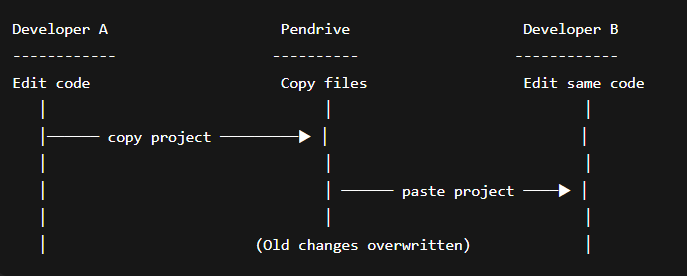
“I’ve updated the login feature. I’ll copy the project to my pendrive and give it to you.”
Another developer edits the same project meanwhile.
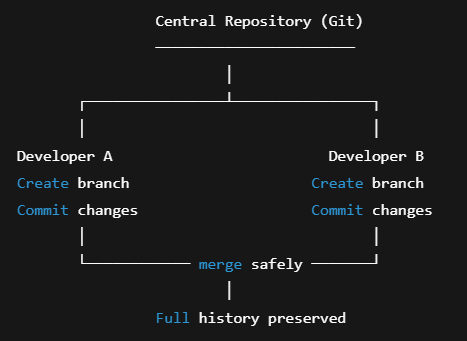
Now there are two different versions of the same codebase—and no clear way to merge them safely.
The Classic Folder Structure
project/
├── project_final
├── project_final_v2
├── project_final_latest
├── project_final_latest_fixed
├── project_final_latest_fixed_REAL
Each folder represents:
Fear of deleting old code
No confidence in changes
No way to track what actually changed
This chaos is exactly why version control systems were born.
The Pendrive Analogy
Think of a pendrive as a very primitive version control system—but without intelligence.
What Pendrives Could Do:
Transfer files from one person to another
Store a snapshot of code at one moment
What Pendrives Could NOT Do:
Track who made changes
Track what changed
Merge changes from multiple people
Prevent overwriting someone else’s work
Maintain a history of versions
So every transfer was a risk.
One wrong copy-paste and:
Days of work vanished
Features disappeared
Bugs reappeared mysteriousl
Problems Faced Before Version Control Systems
Code Overwriting
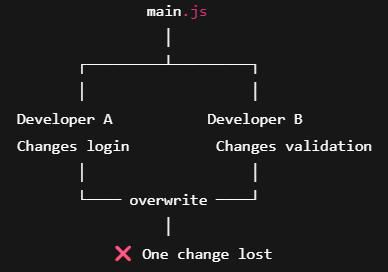
Two developers modify the same file.
Developer A copies code to pendrive
Developer B also makes changes
Whoever copies last overwrites the other’s work
Result: One person’s effort is lost completely.
No Change History
Someone asks:
“Who broke the build?”
No one knows.
There is:
No record of changes
No timestamp
No author information
Debugging becomes guesswork instead of engineering.
No Collaboration Visibility
Teams had zero visibility into:
What others were working on
Which features were complete
Which code was stable
This caused:
Duplicate work
Conflicting implementations
Constant rework
Fear of Making Changes
Because there was no safety net:
Developers avoided refactoring
Bugs stayed unfixed
Code quality degraded
Why?
Because breaking something meant no easy rollback.
Impossible Team Scaling
This approach worked for:
1 developer
Maybe 2 developers
More than that
Large teams became unmanageable.
This is where the pendrive model completely collapsed.
Real-World Team Collaboration Breakdown
Now imagine this at scale:
10 developers
20 features
Daily updates
With pendrives or email-based sharing:
Conflicts are guaranteed
Productivity drops
Deadlines slip
Frustration increases
Software development stopped being about building features and started being about avoiding disasters.
The Turning Point: Why Version Control Became Mandatory
As software systems grew:
Larger
More complex
More collaborative
The industry needed a system that could:
✅ Track every change
✅ Merge work safely
✅ Preserve history
✅ Enable collaboration
✅ Allow rollback
✅ Scale with teams
That system is Version Control.
Modern tools like Git don’t just store code—they store trust.
You can experiment freely because:
Every change is recorded
Every mistake is reversible
Every contributor is accountable